
Endorsed by the International Attachment Network
www.ian-attachment.
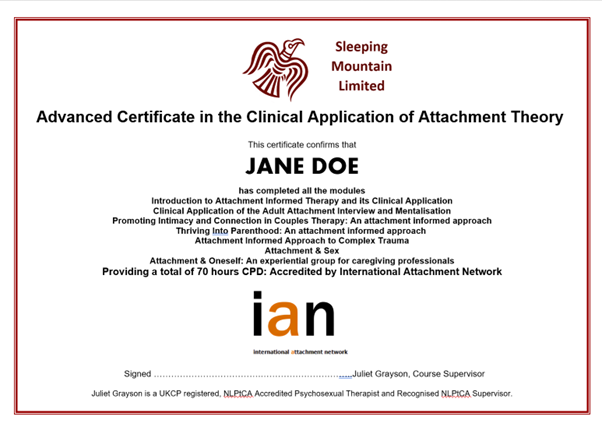
This Advanced Certificate Training is made up of a series of six online modules. The aim is to explore the benefits of working therapeutically in an attachment informed way linking clinical work with attachment research and theory.
Each day of training carries 7 CPD hours (to include 1 hour per day of training as pre-course listening or reading)
Maximum of 18 participants, apart from Module 7 – Attachment and Oneself, which has a maximum of 8 participants.
This will be led by Nicola Jones who is an expert in attachment, and one of our core trainers.
The Series is 6 Modules
Module 1: The Introduction to Attachment course is the gateway to the Advanced Certificate in the Clinical Application of Attachment Theory.
You will receive a certificate of attendance after each module. When you have completed all 6 modules you can apply for the ADVANCED CERTIFICATE that you see above, that you can put on your wall. This provides 70 hours of CPD.
Save 15% When You Book all 6 modules Full Certificate in Clinical Application of Attachment Theory
If you know you’d like to complete the Certificate you can save 15% by booking all seven modules together. NB The in person module 1 on 21 22 March is not included in this 15% discounted offer. Participants can let us know they are booking that (book it direct with IAN on their website https://www.ian-attachment.org.uk/events-cpd) and we will give a 15% discount if you book ALL the remaining modules by filling in this form.
The final price depends on the date when you book, and how that impacts the early booking discount.
- We’ll first apply any current early booking discounts to each individual module
- then take a further 15% off the total.
Click here for more information and to apply for this discount
More About The Series
An attachment-informed approach can make the inner worlds of our clients and patients more visible and is essential to meeting others safely and enabling the exploration of their presenting problems. No other clinical theory yields so much practical information about the theory of human development as attachment theory and no other theory explicitly links establishing a secure base in therapy with a similar process during infancy.
Attachment theory does not dictate a particular form of treatment; rather, understanding the nature and dynamics of attachment and of mentalisation (capacity for curiosity and holding uncertainty) informs rather than defines intervention and clinical thinking (Slade (2008)
You will be able to attend some or all of the modules, and book to attend the ones you want to. However, you will only be given the full Certificate to go on your wall, once you have completed all six modules.
These dates are now available for booking on our website – go to https://therapyandcounselling.co.uk/ and search for the date – click on the link and you will find all the info and a link to book. For ease you can also click on the blue links below.
|
Module 1 Introduction to Attachment Informed Therapy and its Clinical Application |
2026 Oct 16, 17 |
|
Module 2&5 Mentalising, Therapeutic Change, Attachment Trauma and the Adult Attachment Interview |
|
|
Module 3 Promoting Intimacy and Connection in Relationships: An attachment informed approach |
2027 Aug 13 14 2028 Aug 18 19 |
|
Module 4 Thriving Into Parenthood: An attachment informed approach |
|
|
Module 5 Please note: In the first year of running this Certificate Training, Modules 2 and 5 were offered as two separate one-day modules. We have since combined these into one two-day workshop, as we have found that this structure provides a better flow and continuity to the course as a whole. See Module 2&5 above for dates which include the ‘old’ module 2. |
|
|
Module 6 Attachment & Sex |
|
|
Module 7 Attachment & Oneself: An experiential group for caregiving professionals |
DETAILED CURRICULUM
ADVANCED CERTIFICATE IN THE CLINICAL APPLICATION OF ATTACHMENT THEORY
Accredited by the National Council for Integrative Psychotherapists and endorsed by the International Attachment Network.
A series of online courses to explore the benefits of working therapeutically in an attachment informed way linking clinical work with attachment research and theory.
Each day of training carries 7 CPD hours (to include 1 hour per day of training as pre-course listening or reading)
Maximum of 18 participants unless otherwise stated.
Module 1 is a prerequisite to the all other modules. You can attend the other modules in any order that suits you.
Introduction to the Series
An attachment-informed approach can make the inner worlds of our clients and patients more visible and is essential to meeting others safely and enabling the exploration of their presenting problems. No other clinical theory yields so much practical information about the theory of human development as attachment theory and no other theory explicitly links establishing a secure base in therapy with a similar process during infancy.
Attachment theory does not dictate a particular form of treatment; rather, understanding the nature and dynamics of attachment and of mentalisation (capacity for curiosity and holding uncertainty) informs rather than defines intervention and clinical thinking (Slade (2008))
Module 1. Introduction to Attachment Informed Therapy and its Clinical Application
NB This course is a pre-requisite to all the other modules. If you have already done the ‘Attachment Informed Couples Therapy’ training with Nicola (between 2019 and 2025), then we recommend that you attend this course as a refresher and will give you a discounted rate of 50% of the current price. However, having attended the attachment informed couples training (between 2019 and 2025) you are eligible to attend all the other attachment modules in this certificate training.
Duration: 2 days
Timing: 9.30 to 5.00 (including 50 minutes of breaks & 40 minutes lunch – total 1 hour 30 mins)
John Bowlby found that our first and most fundamental need is to connect to our parents (primary caregivers) and that this need, also known as the attachment or care seeking system, exists from cradle to grave. The corollary of this is that attachment theory is as applicable to adults generally and particularly in intimate relationships, as it is to children and it is this link which gives the insights into the origins of clients’ personalities enabling more attuned interventions. Overall, this will enhance therapists’ capacity for empathy and the quality of the therapeutic alliance
What you can expect from this workshop is to:
- Learn how personality develops (and one’s attachment style) securely or insecurely, from the quality of the parental caregiving relationship
- Identify avoidant and preoccupied attachment styles from 3 interlinking perspectives and hypothesise about individuals’ inner worlds corresponding to each style i.e their beliefs about and expectations of self, others and relationships
- Explore the essential characteristics of each of the basic human needs (motivational systems) of careseeking, caregiving, self defence (fear) and interest sharing. Learn to identify when these systems are underdeveloped or used defensively enabling clearer assessments and more targeted therapeutic interventions
- Identify various, fearful, ways in which clients come to therapy (seek care) and recognise, and prepare to meet these differing presentations
- Expand understanding of clients’ resistance to change and associated self-defeating patterns of behaviour
- Explore the process of change with emphasis on the implicit, non-verbal aspects of the therapeutic relationship
- Learn various ways to access clients’ attachment histories and identify events which significantly shape family systems and the individual’s place within the system
- Explore the impact of one’s own attachment style on the therapeutic relationship
Learning will be through presentation, video clips of relevant research, large and small group discussions using a case study and skills practices. Some pre course preparation will be given along with handouts and a list of additional resources
Module 2 & 5. Mentalising, Therapeutic Change, Attachment Trauma and the Adult Attachment Interview
Requirement: The prerequisite for attending this course is Module 1: The Introduction to attachment informed therapy and its clinical application
Duration: 2 days
Maximum Numbers: 18
This course replaces the old Module 2 and the old Module 5 – we call this new module Module 2&5
The overarching message of this module is that therapeutic change is closely connected to the development and restoration of the capacity to mentalise, also known as reflective functioning (RF), in therapeutic change and the resolution of attachment trauma. The programme is grounded in the understanding that the sense of self develops through being mentalised within relationships and that this developmental process continues throughout life. Mentalising therefore provides an important framework for understanding both psychological difficulties and the therapeutic relationship, particularly when working with clients who have experienced insecure attachment, developmental trauma or adverse early experiences. By helping clients develop a more reflective understanding of their internal experiences and of other people’s minds, therapy can provide an opportunity to make sense of attachment experiences, the unconscious expectations of self and others which have ensued and develop new ways of relating.
What you can expect from this workshop is to:
- Understand the development of mentalising/RF and its relationship to the phenomena of representation and the concept of internal working models
- Identify reduced or disrupted mentalising/RF and explore how it can affect emotional regulation, relationships, self-understanding and leads to ineffective or no strategies to manage distress
- Practice and develop one’s own capacity to mentalise more effectively within clinical situations and bring greater empathy to difficult situations
- Learn the links between the Adult Attachment Interview (AAI) and mentalising and how the AAI can be used clinically
- Practice AAI questions, experience their clinical value and learn how to identify attachment styles by assessing the coherence of how a person responds to the AAI questions
- Explore how patterns associated with insecure or traumatic relationships can be transmitted across generations
- Learn the key research and theory which links trauma with attachment experiences in early years
- Learn the basic neuroscience of trauma
- Identify the clinical presentation of trauma, and the ways in which individuals may defend against traumatic memories and associated emotional experiences including shame and guilt
- Apply an attachment informed approach to attachment trauma including the McCluskey systems model of the self.
- Reflect on the therapist’s own emotional regulation and self-care when working with attachment complex or emotionally difficult material
Throughout the programme, participants are encouraged to connect theory with clinical practice. Learning is supported through presentation, discussion of a video interview concerning attachment trauma, small and large-group discussion, experiential learning and skills practice. You will be encouraged to bring your own case work to apply the course learning.
Module 3. Promoting Intimacy and Connection in Relationships: An attachment informed approach
Requirement: The prerequisite for attending this course is Module 1: The Introduction to Attachment informed therapy and its clinical application
Duration: 2 days
Maximum Number: 18
Attachment theory links the needs we have in early years with those which arise in intimate relationships which tells us that the presence of a supportive partner is fundamental to personal wellbeing and guides the reparative work which is needed . Building on the Introduction Course this training explores how couples’ different experiences of being cared for in their early years (their attachment history) is at the heart of their presenting problems, taking a look at the prevalent issues such as conflict, distance, disconnection, lack of intimacy and poor communication. The workshop looks at the challenges of emotionally regulating a couple and builds the skills required to connect them to their more resourceful and empathic selves to access intimacy and move from feelings of intense loneliness
What you can expect from this workshop is to:
- Appreciate how healthy relationships develop and link with wellbeing
- Consider some of society’s misleading, confused and uninformed messages about phenomena such as attraction, love, desire, sex and intimacy which creates unrealistic expectations, power imbalances, stress and separation
- Identify and explore the interaction of attachment styles and internal working models (‘an individual’s unique attachment style’) in a couple and learn to identify the patterns of interaction in which couples of varying attachment styles get stuck
- Consider how the basic needs/motivational systems (careseeking, caregiving, sex, self-defence and interest sharing) manifest in couple relationships enabling more targeted assessment and illuminating the way through unhelpful, repeating patterns
- Identify key triggers of the attachment (care seeking) system and the ensuing patterns of interaction and their links to each individual’s personal history
- Learn tools, skills and practical strategies to help couples be more emotionally regulated and able to access their empathy for self and their partner
- Identify and avoid common pitfalls of working with couples
- Reflect on the differences between individual work and couples work with particular regard to the therapeutic alliance and maintaining safety
Learning will be through presentation, large and small group discussions, role plays with a case study, skills practices and trainer demonstrations. Some pre course preparation will be given along with handouts and a list of additional resources
Module 4. Thriving into Parenthood: An attachment informed approach
Requirement: The prerequisite for attending this course is Module 1: The Introduction to attachment informed therapy and its clinical application
Duration: 2 days
Maximum Number: 18
The impact on individuals and couples becoming parents is monumental yet this is not mirrored in the attention which society pays to this life changing experience, leading to unnecessary parental suffering which will inevitably affect the infant
‘It (becoming a parent) took the lid off what I didn’t know about my family dynamics and changed everything’ (personal communication with a client)
What you can expect is to:
- Know what conversations to open up: from expectations of being a parent, the experience of pregnancy and birth and its impact on the parent(s), the many changes and challenges including money, careers, differing needs of each parent, impact on each parent, relationships with family and friends and on intimacy as examples
- Facilitate parents to think about how their own childhood experiences surface and affect their attitudes to and expectations of their infant and how this may impact their ability to listen to their children when difficult feelings are evoked
- Appreciate and explain key research such as the importance of the couple relationship, the impact of parental conflict on children and Good Enough Mothering (Hopkins 1996)
- Recognise and manage parental re-enactments, projective identification, the effects of role reversal in childhood and parental mentalisation with discussion of Ghosts in the Nursery (Fraiberg 1975) and Angels in the Nursery (Lieberman and others 2005)
- Learn the common patterns caused by anxiety in family systems, the relationship between attachment patterns and parenting style supported by the Adult Attachment Interview and the Strange Situation Protocol
- Review the caregiving system and the developmental importance of exploratory caregiving
- Identify and discuss common issues relating to step parenting, sibling relationships and contemporary challenges to parenting
Learning will be through presentation, large and small group discussions, videos, a case study, and skills practices. Some pre course preparation will be given along with handouts and a list of additional resources
Module 5. Look above for Module 2 & 5
Module 6. Attachment and Sex
One day 9.30 to 5.00 (50 minutes of breaks & 40 minutes lunch – total 1 hour 30 mins)
Requirement: The prerequisite for attending this course is Module 1: The Introduction to Attachment informed therapy and its clinical application
This workshop looks at how attachment dynamics show up in adult intimate relationships.
What you can expect is to:
- Discuss healthy (affectionate) sexuality in the context of the motivational systems (care seeking, caregiving etc.) and associated neuroscience
- Learn how the sexual system develops from birth through adolescence and puberty and interacts with the attachment system thereby identifying the developmental roots of sexual anxieties
- Appreciate the impact of sub-optimal caregiving (attachment history) and complex trauma (attachment trauma) on individuals’ sexual systems (including power dynamics, perversions, cut off sex, over sexualisation, paraphilias, sexual addiction and stalking)
- Reflect on the impact and internalisation of messages about sex from family, society and intergenerational issues
- Consider the impact on individuals and couples of IVF, links with becoming parents and ageing
- Presentation of the sexual system in clinical practice
- Clinically define phenomena such as desire, sensuality, intimacy and attraction and link attachment histories with desire and intimacy
Learning will be through presentation, large and small group discussions, a case study and skills practices. Some pre course preparation will be given along with handouts and a list of additional resources
Module 7. Attachment and Oneself: An experiential group for caregiving professionals
One day 9.30 to 5.00 (50 minutes of break and 40 minutes for lunch – total 1 hour 30 mins)
Maximum Number: 8
Requirement: The prerequisite for attending this course is Module 1: The Introduction to Attachment informed therapy and its clinical application
In this small experiential group you will be facilitated to explore your own experiences of careseeking and caregiving in a safe environment using the group model of Una McCluskey. Maintaining an environment of safety, to enable exploration, has been central to McCluskey’s work. This exploration will support all clinical work and particularly working with complex trauma issues.
The care seeking system will be explored in the morning and the caregiving system in the afternoon. There will be a very brief explanation of each system before each section.
McCluskey’s article ‘The Fear Free Caregiver’ will be circulated in advance.